
The Kalachakra Sand Mandala
An essay by Arizona Friends of Tibet President Steve Rosalik, helping to introduce our 2025 Sand Mandala Event
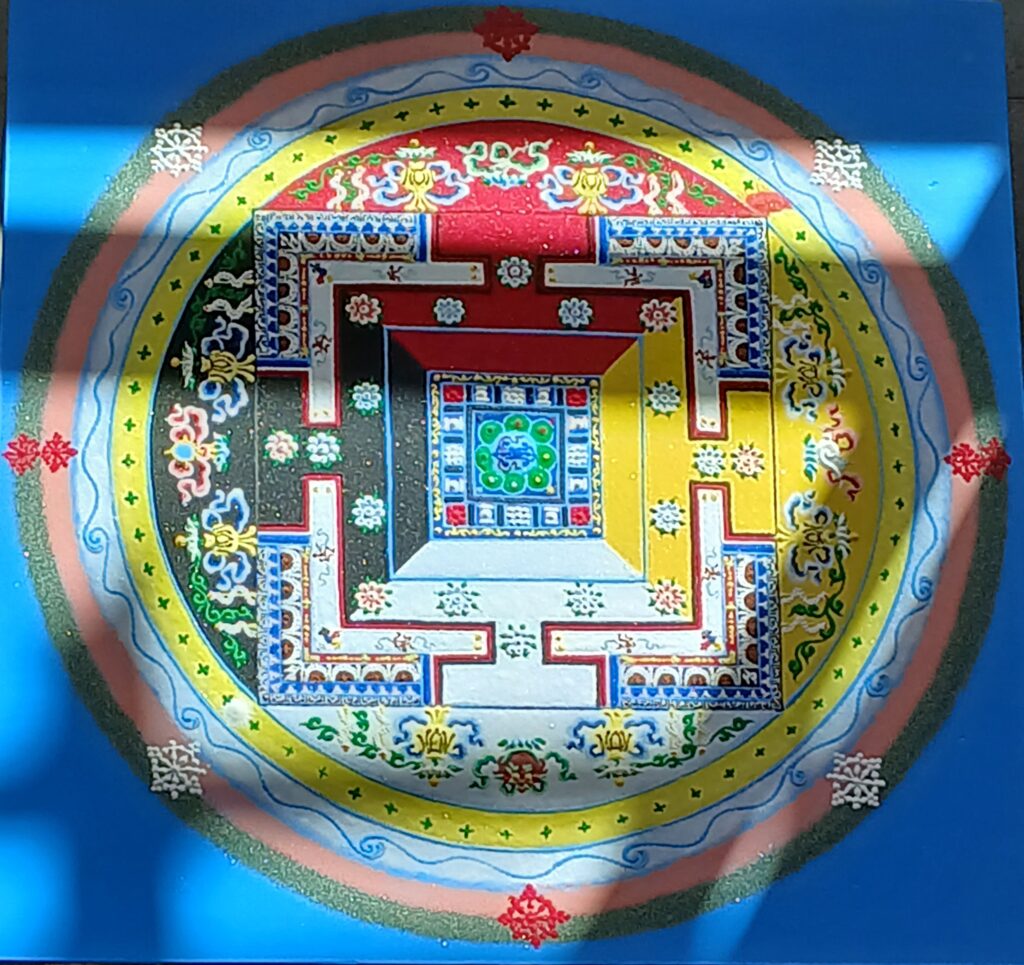
overhead view of the richly detailed and colorful Kalachakra mandala, with morning light slanting across it
2025 Kalachakra Sand Mandala by Losang Samten
The design chosen for our sand mandala, Kalachakra, is not only a teaching, but also a medicine for our time. Words cannot do justice to its fragile beauty, but I would like to share a few reflections on what it may mean for us today.
Sixty-two years ago, from a jail in Alabama, Dr. King wrote that “We are caught in an inescapable network of mutuality, tied in a single garment of destiny. Whatever affects one directly, affects all indirectly.” In an age shaped by the internet and media, his words now read not only as truth but as prophecy. Dr. King sought peace—not the easy peace of avoidance, but a “positive peace,” the peace that comes only with collective and personal transformation. We have yet to learn this lesson.
How will we learn it?
Transformation—whether personal or collective—depends on imagination. James Hollis reminds us that “suffering seems to be a prerequisite for the transformation of consciousness.” Pain, then, might be the seed of change. The question is whether we can imagine something beyond the pain, and if so, how we might bring it into being.
We look to the Amazon rainforest for undiscovered medicines to heal the body. Its preservation is vital because it sustains the breath of the planet itself. But what if our deepest afflictions are not physical? What if the sicknesses that most endanger us are emotional, intellectual, or spiritual?
Here Tibet becomes as vital as the Amazon. For centuries it was largely sealed off from the outside world, cultivating a culture and spiritual tradition unlike any other. That culture is endangered today. Yet, like the forest, it carries medicines—teachings and practices—that may help heal the invisible wounds we share.
At Arizona Friends of Tibet, we believe the Kalachakra is one of these medicines. It is a reminder that we are bound together, that separation is an illusion, and that the change we most long for begins within ourselves. We do not transform one another directly; rather, we become people whose presence awakens transformation in others. In this way, change spreads—quietly, steadily—until, as Thoreau once imagined, “music and poetry would resound along the streets.”
This is not fanciful; it is a possibility. But to know it, we must see for ourselves.
So we invite you to join us in Tucson at the Andrew Weil Center, where Venerable Losang Samten will create the Kalachakra sand mandala. Since his first visit to the West, Losang-la has returned his monastic robes but not his vows to serve all beings. For decades he has worked tirelessly to share this sacred art, to teach the dharma, and to establish centers of practice—including the Chenrezig Tibetan Buddhist Center of Philadelphia, the city where he now lives with his wife.
Come and see. Imagine with us.
Steve Rosalik
President
Arizona Friends of Tibet
October 2025