October 2025 Sand Mandala Event
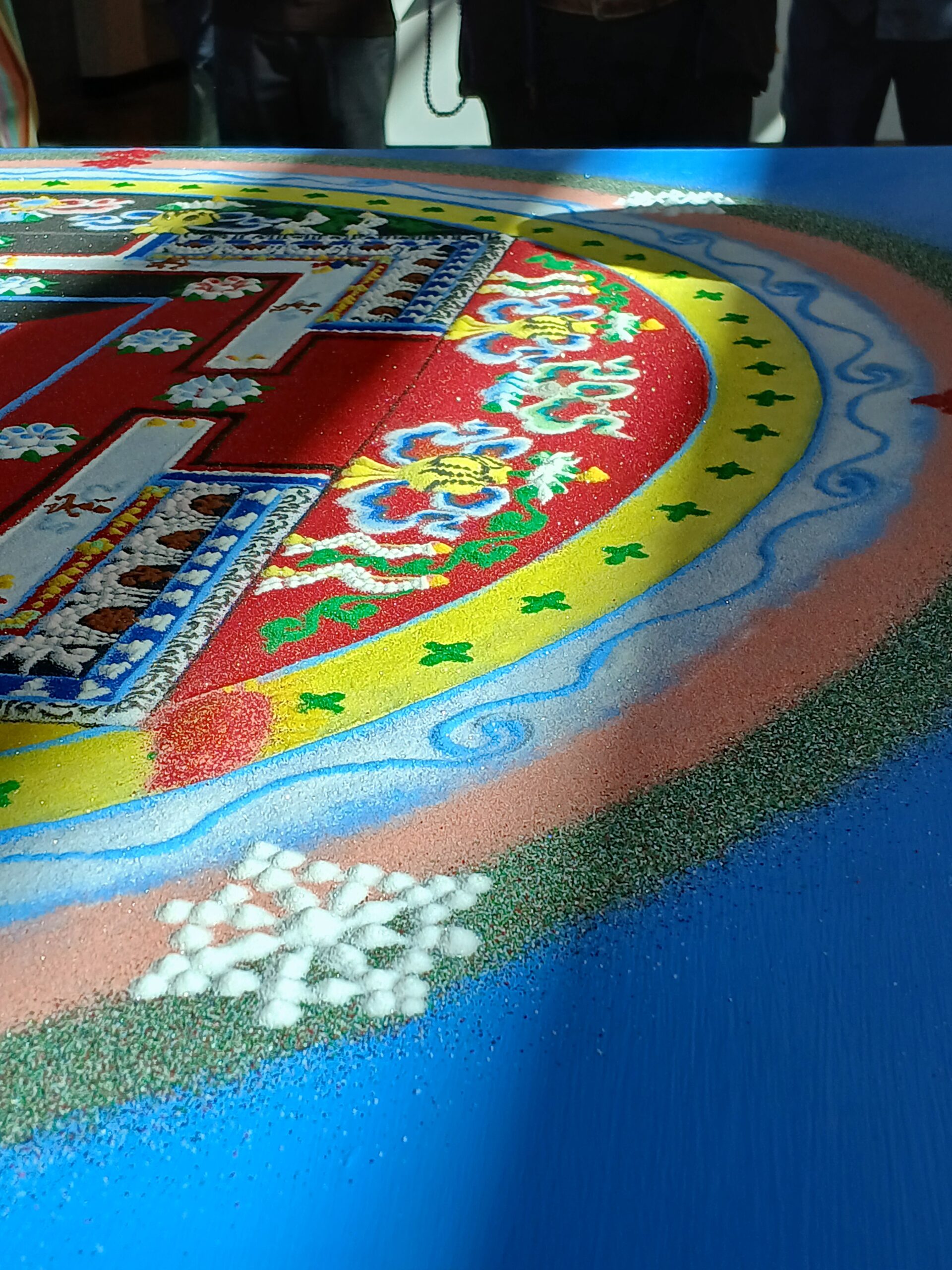
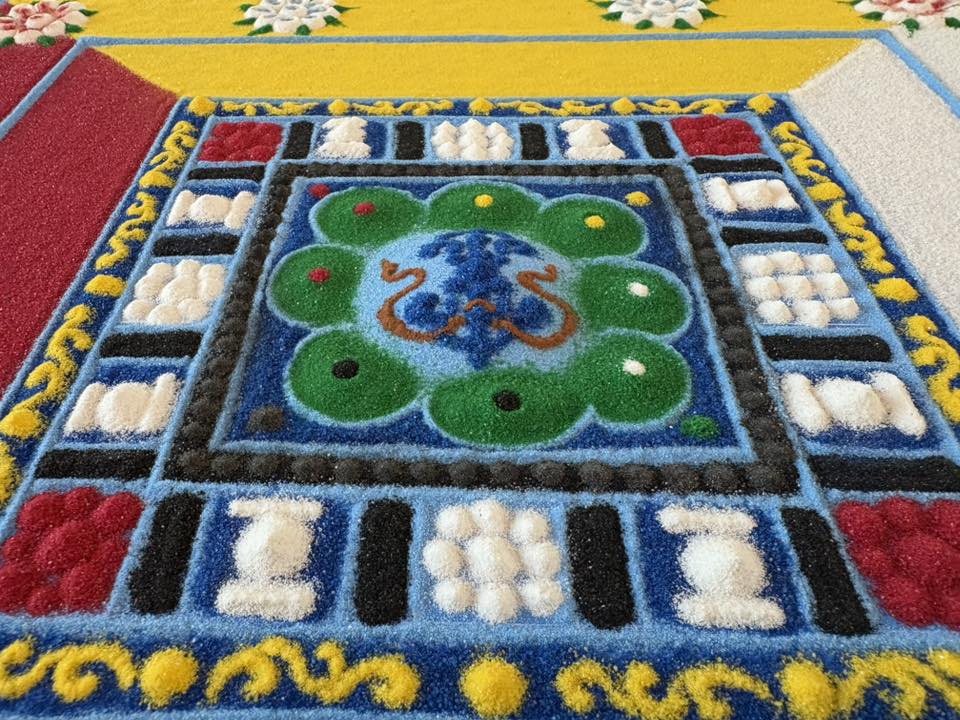
In October 2025, Arizona Friends of Tibet had the honor of hosting revered sand-mandala artist Venerable Lama Losang Samten for a week-long sand mandala event. The featured mandala was a Kalachakra, or “Wheel of Time” mandala, simplified for our timeframe but still incredibly complex and detailed and deeply meaningful.
Throughout the week, Losang-la made people feel welcome, answered questions, and kept us entertained with characteristic good humor. He invited visitors -including a few classroom groups from both a nearby elementary school and the university – to add sand each day, and the design slowly unfolded. With this emphasis on community participation, by the time the richly colored mandala was complete, it was truly our sand mandala.
The sand mandala was presented in partnership with the College of Humanities 2025 Tucson Humanities Festival and hosted by the University of Arizona: Center for Buddhist Studies, Health Humanities Hub, Department of Religious Studies and Classics, Department of East Asian Studies, and the Andrew Weil Center for Integrative Medicine.
All photos, videos, and text on this page are Copyright 2025 by Arizona Friends of Tibet. Downloading photos for personal use is welcomed. For commercial use, please contact us at info@afot.org.
Resources for more information
- Biography of Venerable Losang Samten
- About the Kalachakra mandala – an article by Losang-la
- Introducing our mandala – an essay by AFOT President Steve Rosalik
- A film about the 1980 Kalachakra initiation performed in Wisconsin by the Dalai Lama – featuring a sand mandala that Losang-la and HHDL both contributed to
- The song Losang-la selected for us to sing together at the closing ceremony
- Articles in the Tucson Sentinel: opening and closing
Preparations
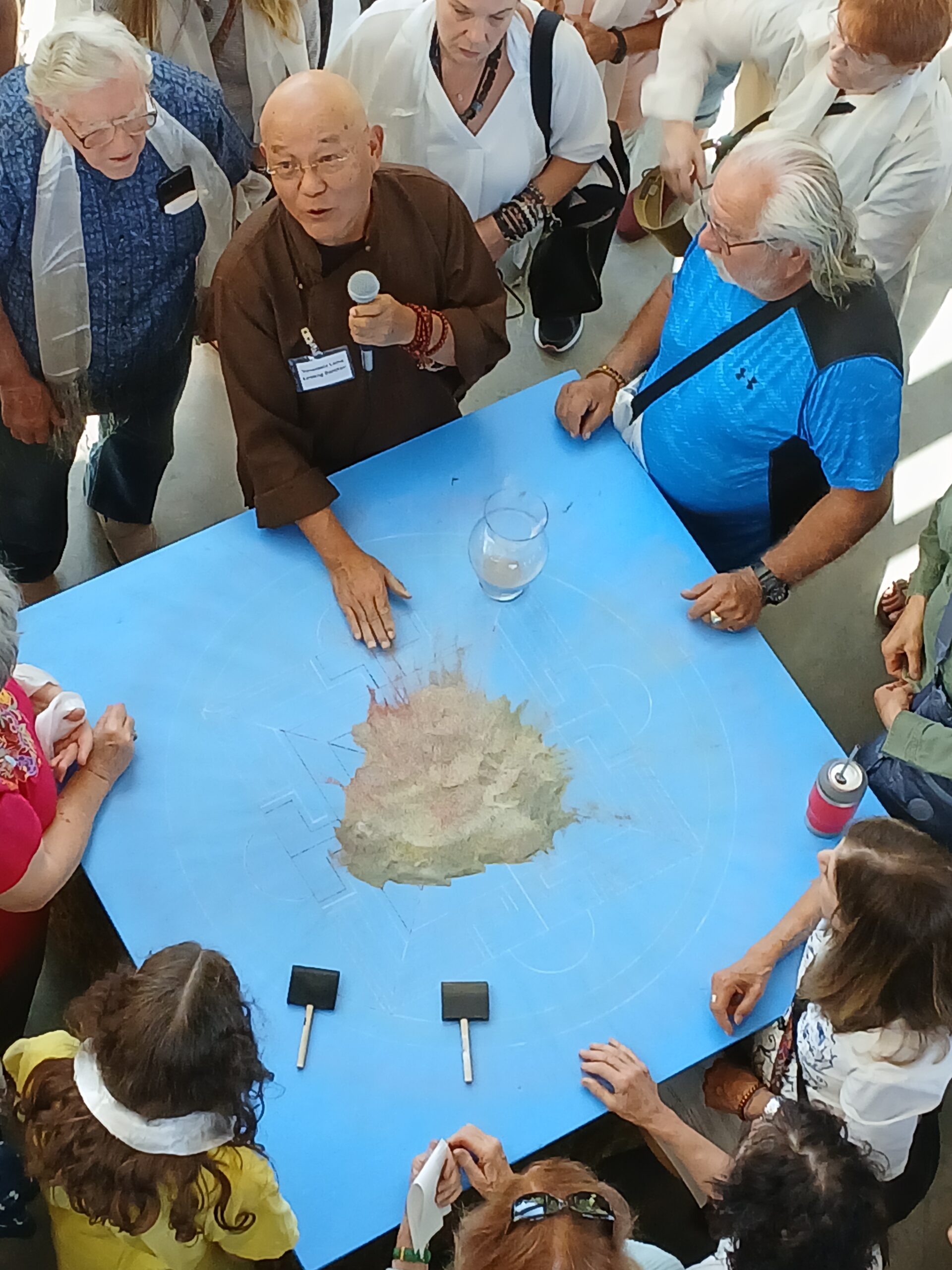
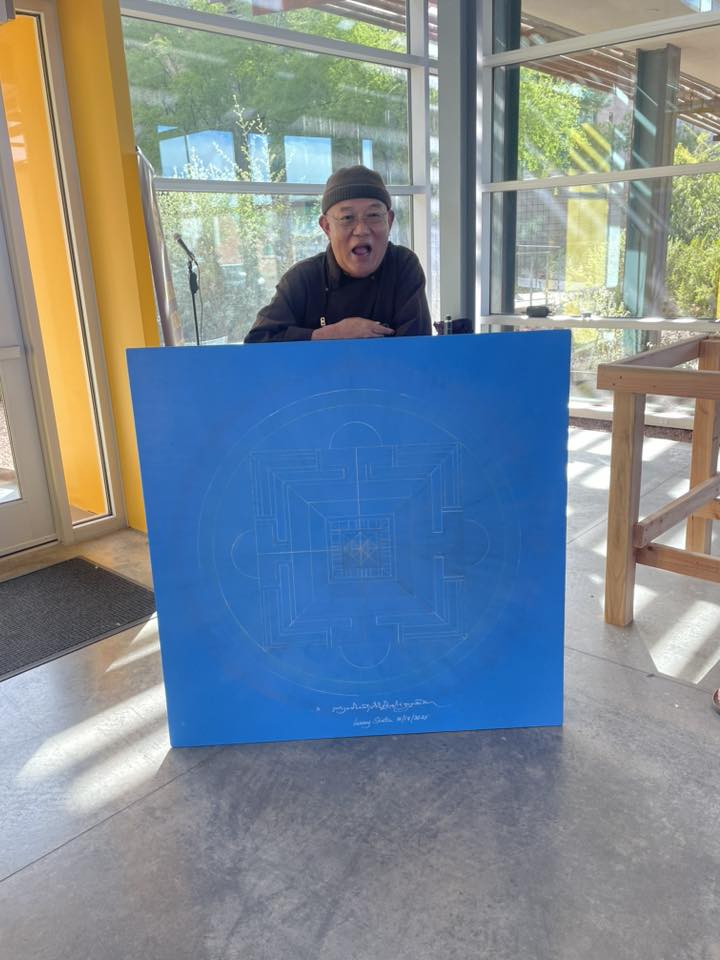
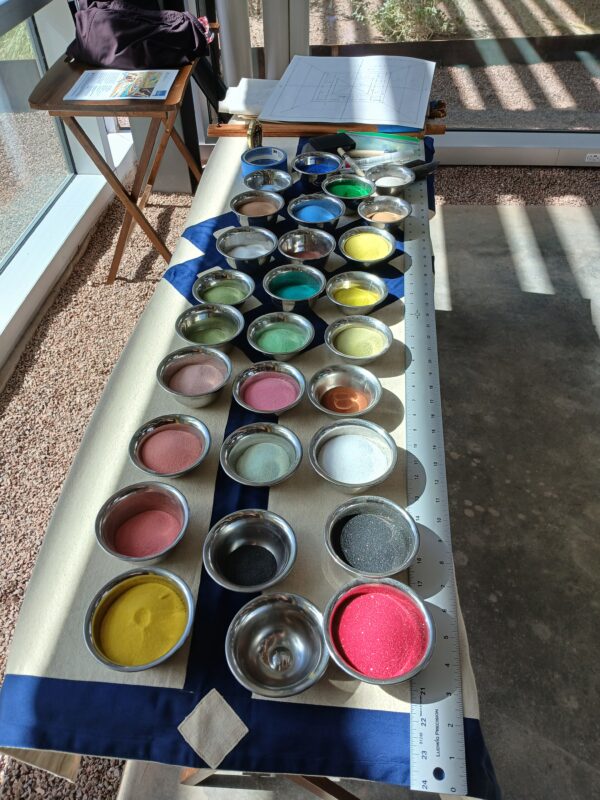
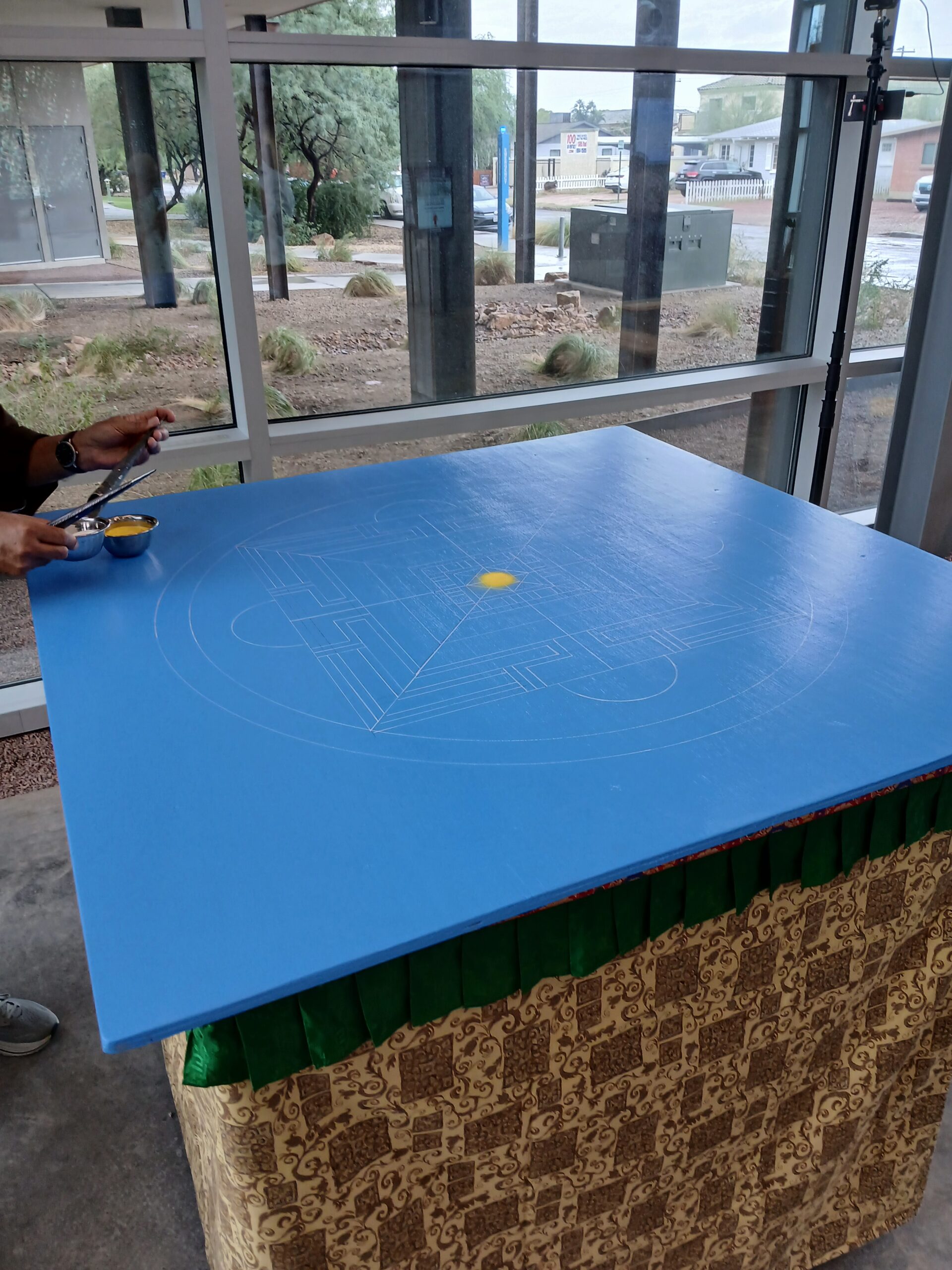
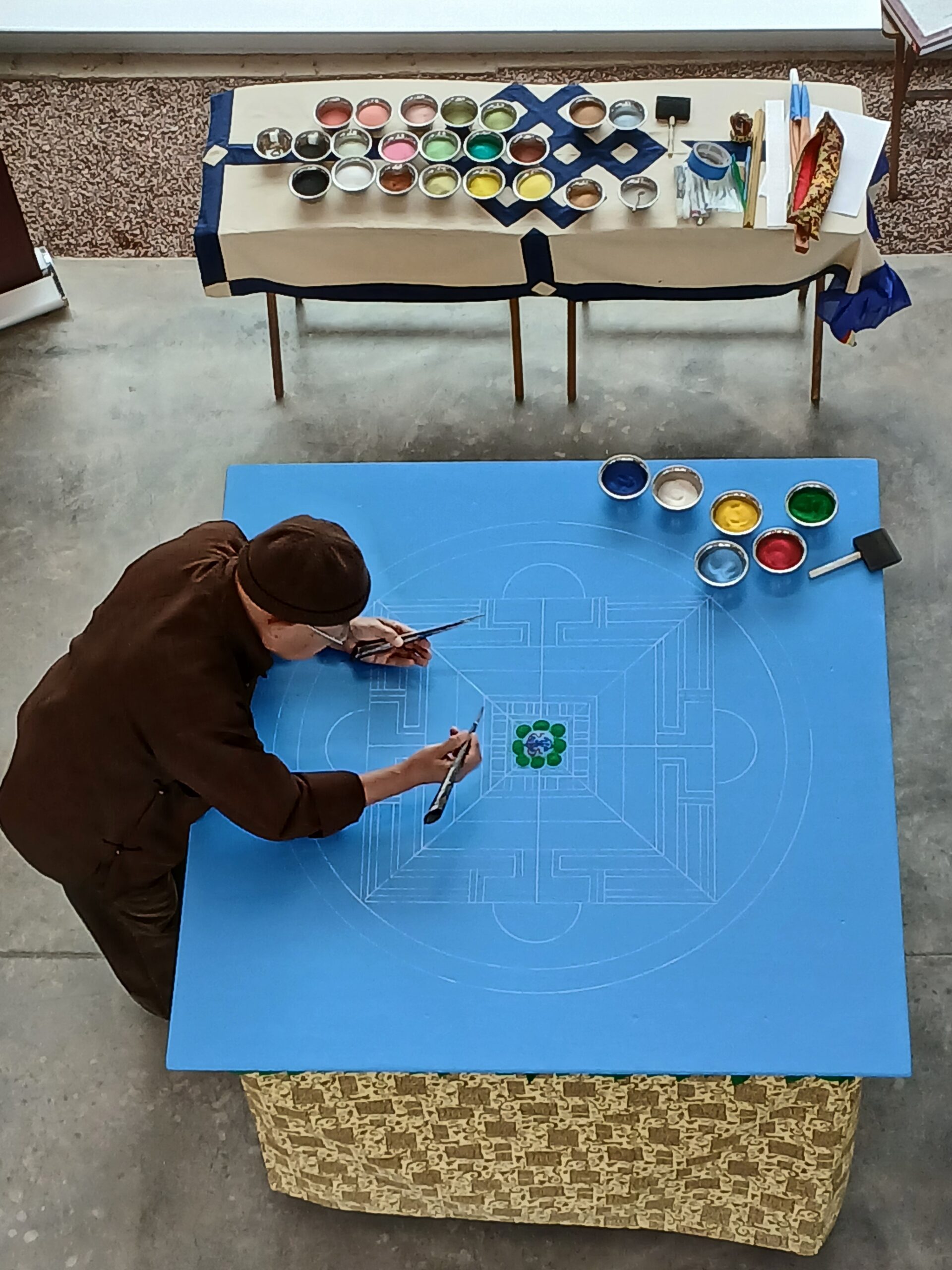
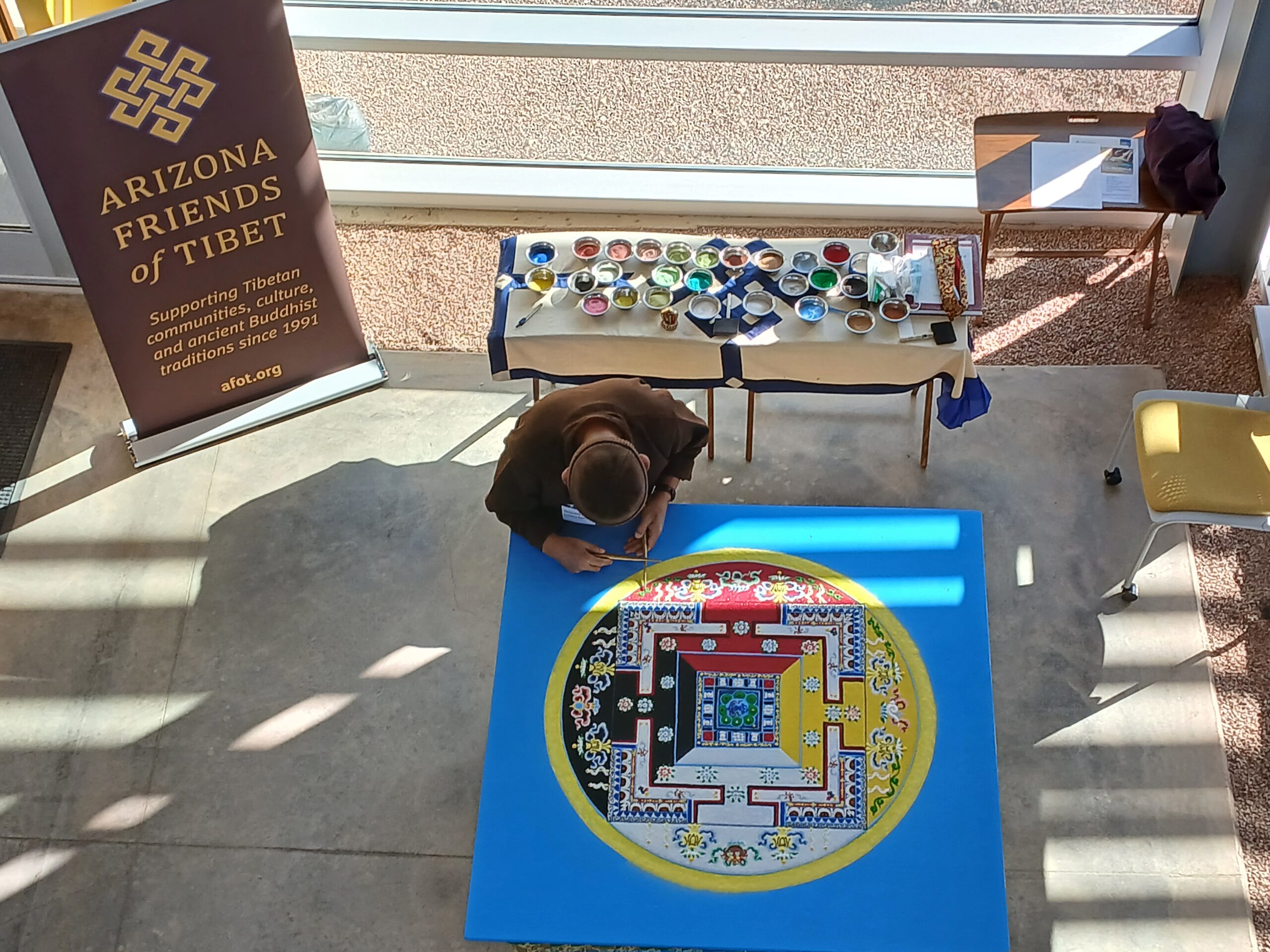
As with most art forms, before a sand mandala can be created, a lot of preparation is necessary. This is especially true of the Kalachakra mandala, which contains a complex arrangement of symbols and images in each tier (and there are several tiers in the temple this mandala represents). Losang Samten put in many hours of work to be ready to start on day 1 of our event. In the months before he returned to Tucson, in addition to his time spent in private study and meditation, Losang-la selected and colored the sands for the design, wrote chants, and “did the math” to be able to lay out the blueprint for the design. (You can get a peek at this blueprint near the top of the photo at left.)
Here in Tucson, we at Arizona Friends of Tibet had to find a space that would honor tradition, offer protection for the mandala, and allow visitors to view the work in progress. Imagine our delight with the space the University of Arizona offered to us: the beautiful lobby at the Andrew Weil Center for Integrative Medicine, which itself has multiple tiers, plus two glass walls and a stunning photography display that make nature part of the space. It couldn’t have been more perfect for the Kalachakra.
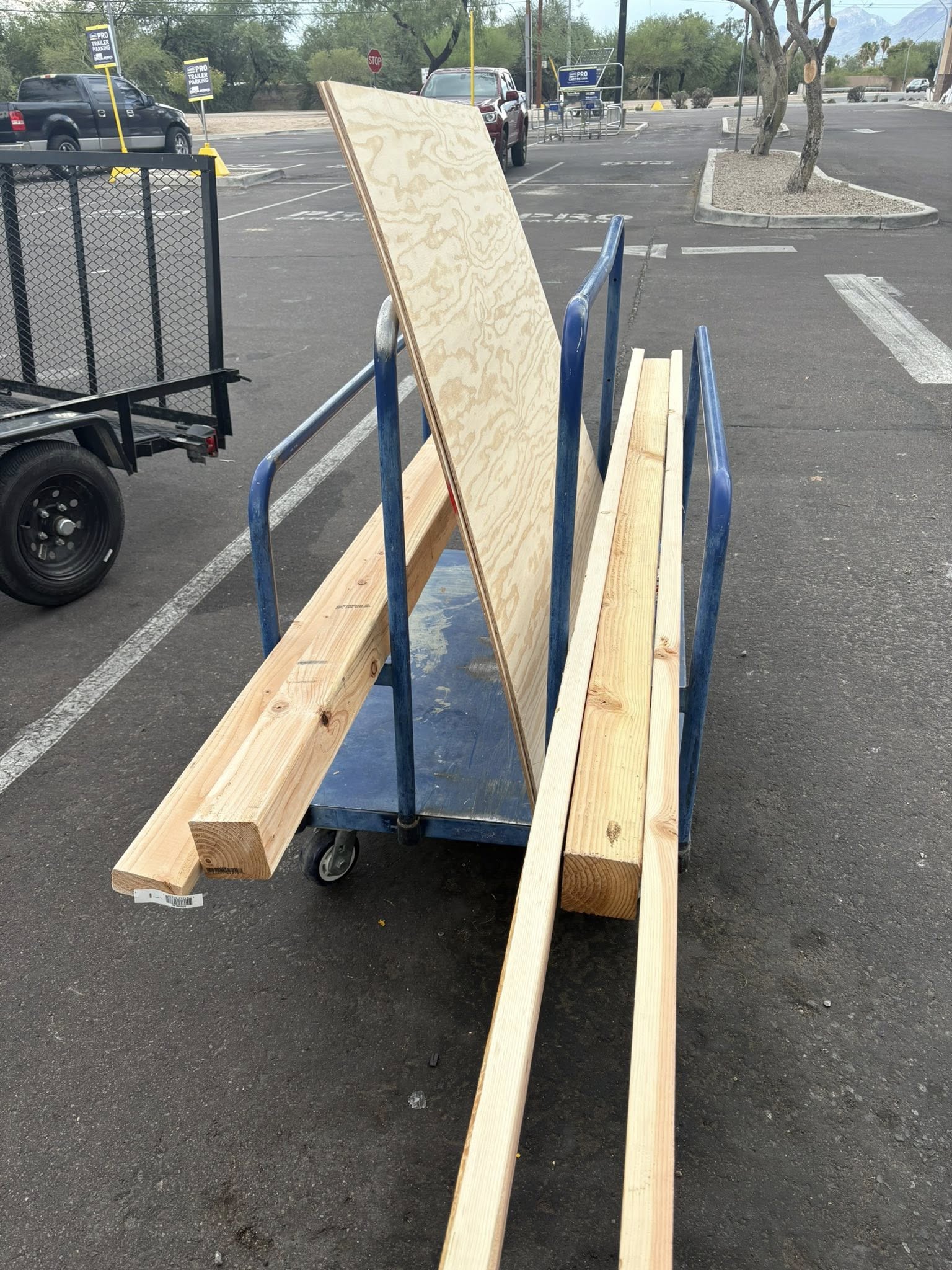
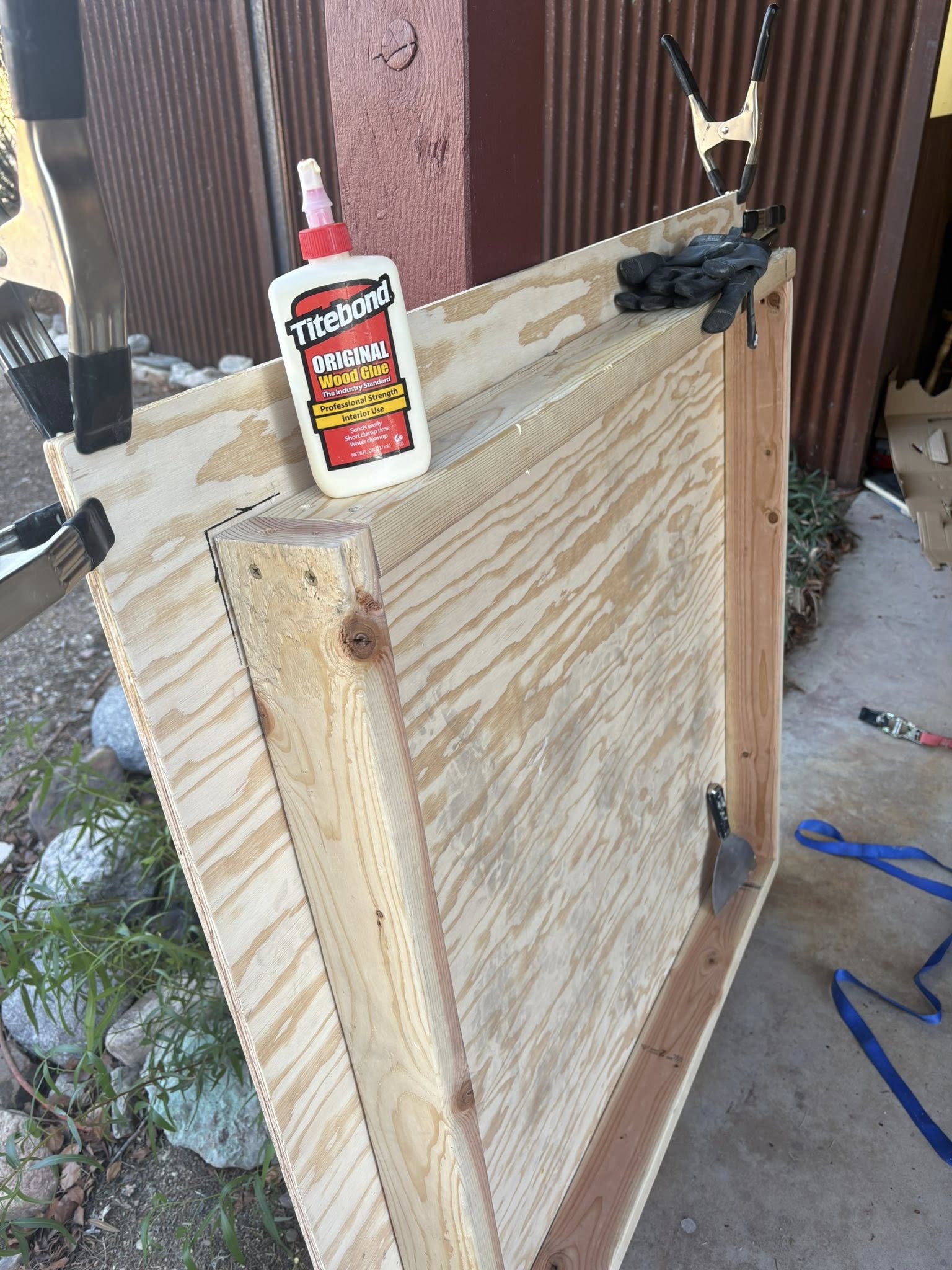
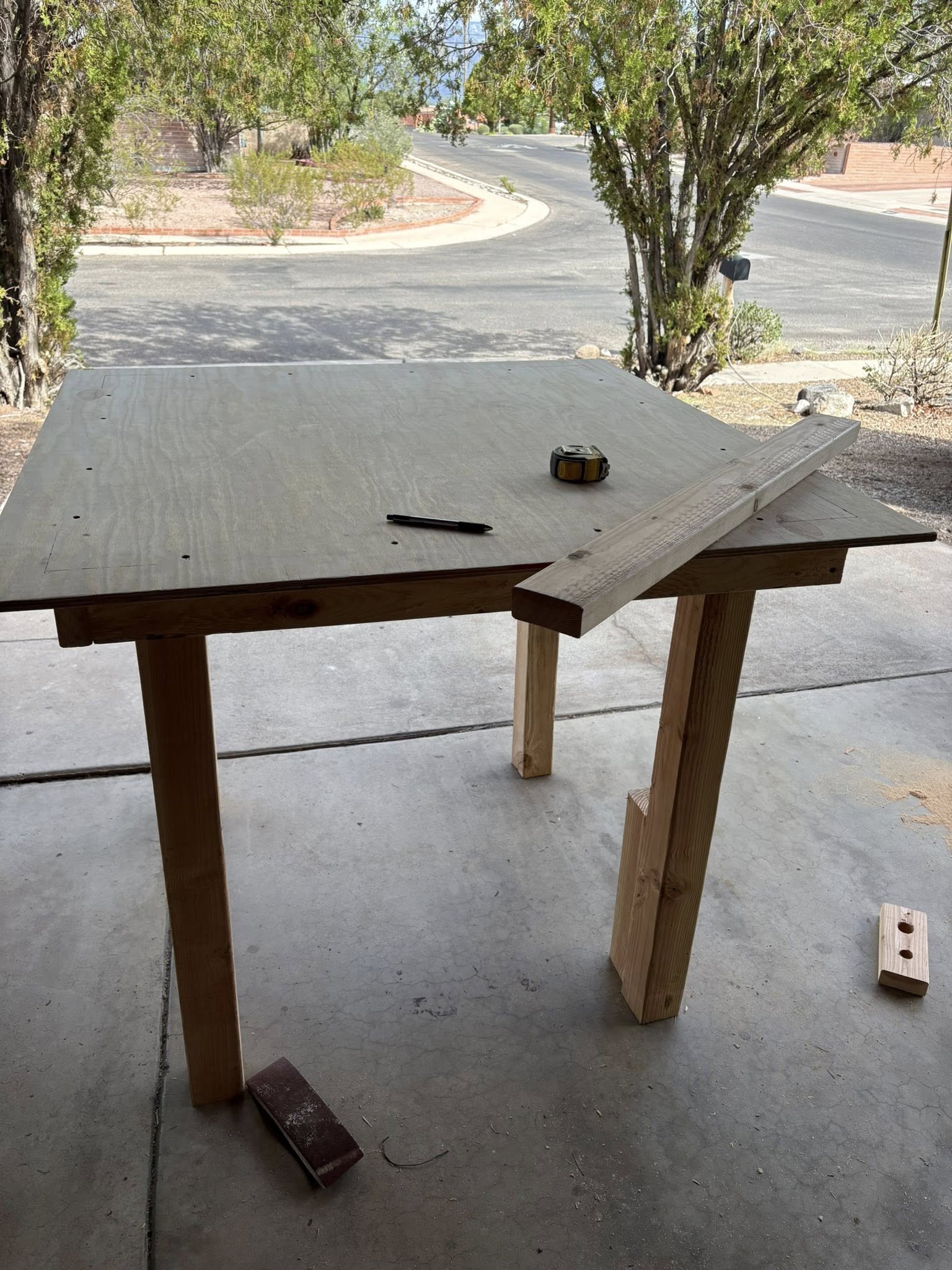
We also enlisted the carpentry skills of a couple of our board members, who prepared — to Losang’s specifications — the work table where the mandala was built.
Opening Ceremony
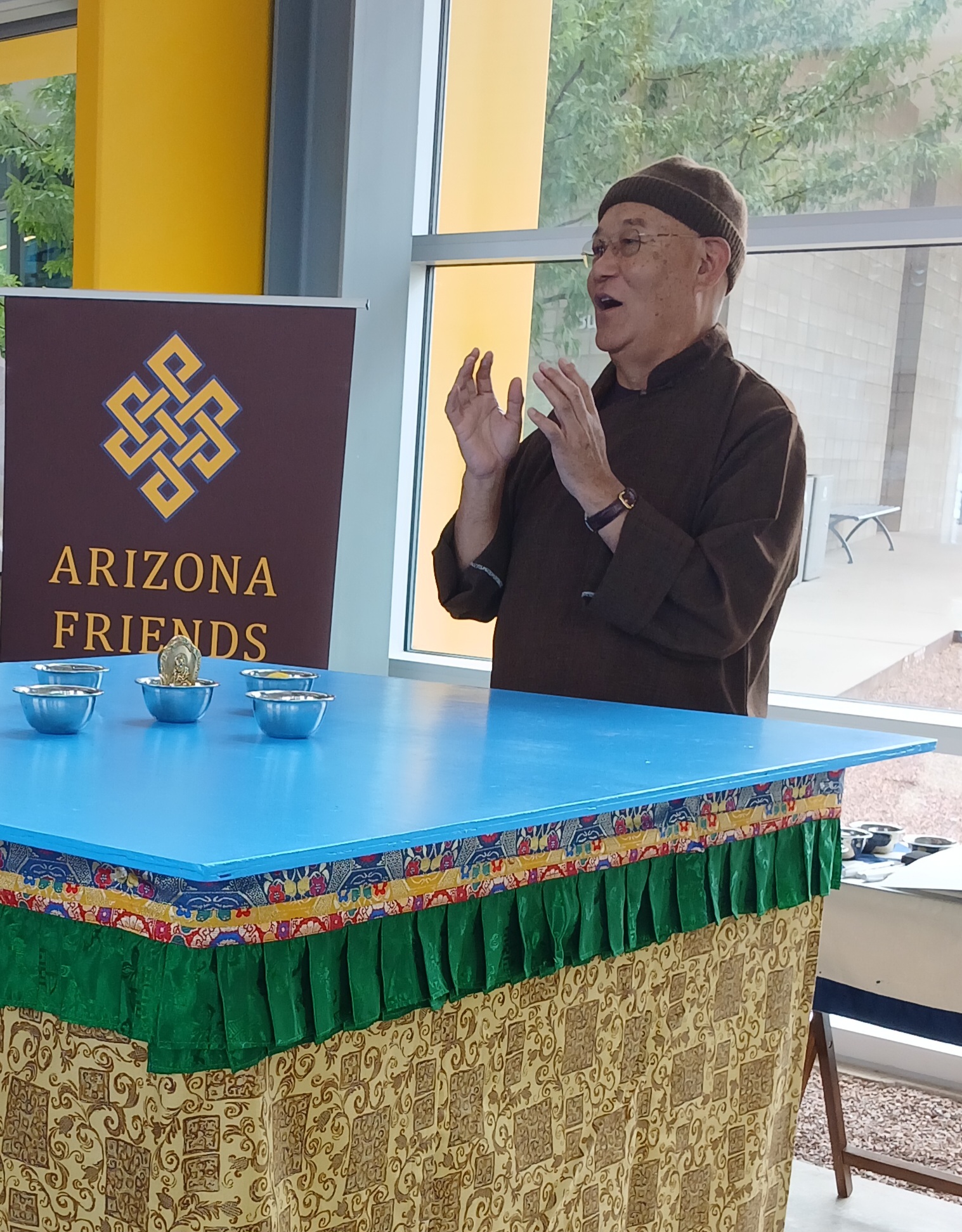
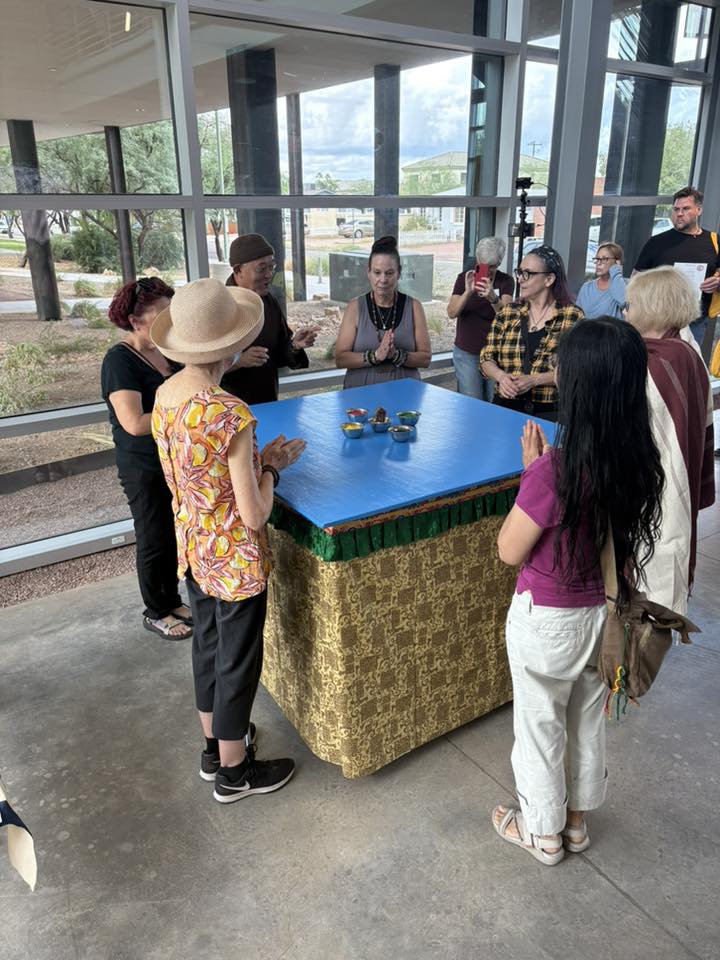
On Sunday, Losang-la conducted the opening ceremony for the sand mandala. He welcomed visitors and then began by blessing the sand and the worktable for our mandala, before inviting visitors to join him in his Kalachakra chant.
With the beautiful lobby of the Andrew Weil Center for Integrative Medicine established as a sacred space for the construction of this most profound of Tibetan Buddhist sand mandalas, work on the mandala could begin.
The Kalachakra mandala is, as we’ve said, complex, and the design requires geometric precision. Losang spent hours before arriving in Tucson to prepare a schematic for this design. With work under way, he used a variety of compasses and rulers to lay out an intricate pattern of chalk lines and circles on his blue worktable.
Perhaps our favorite tool during this phase was his large homemade compass, which you’ll see in the video and photos here.
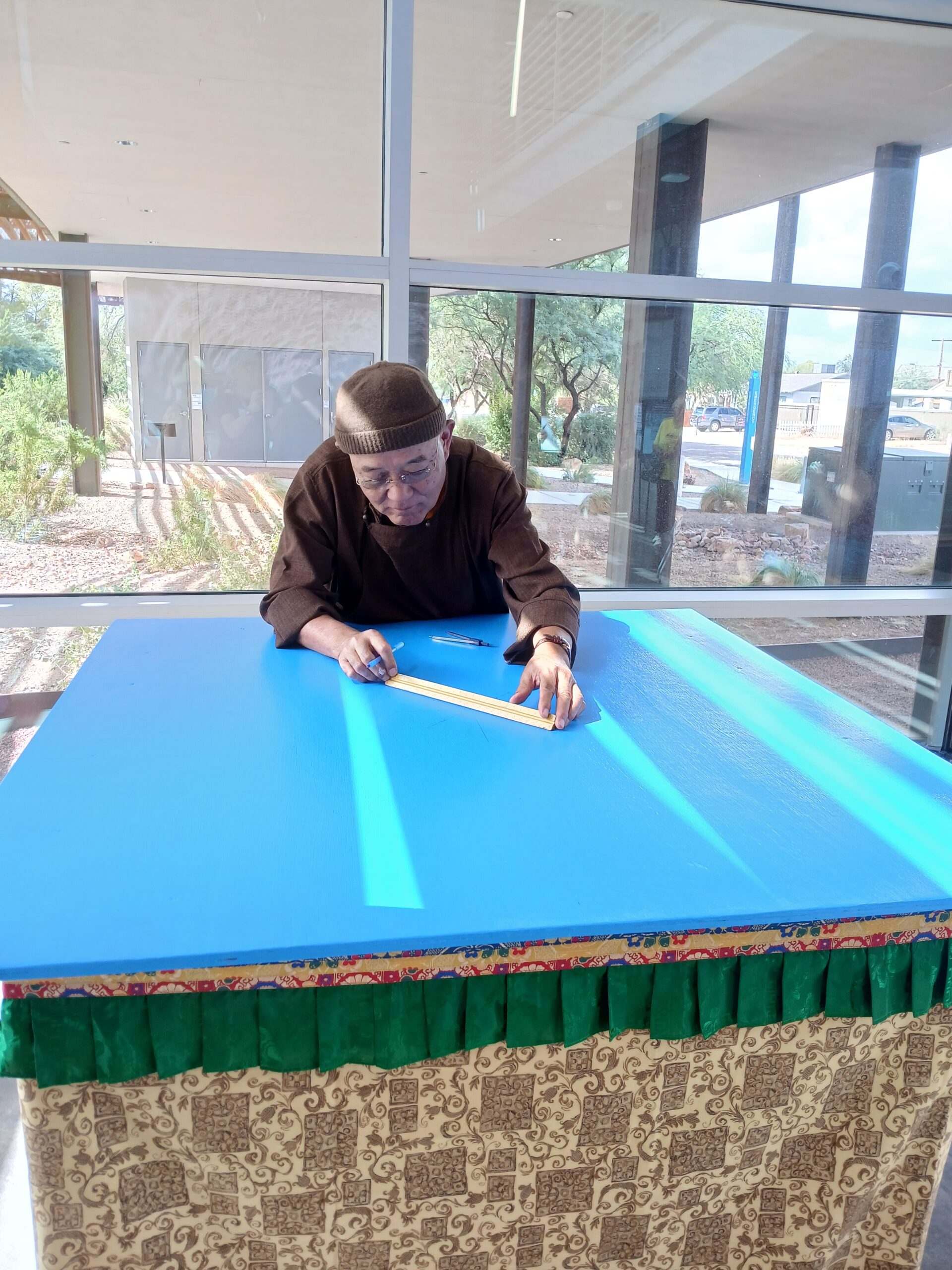
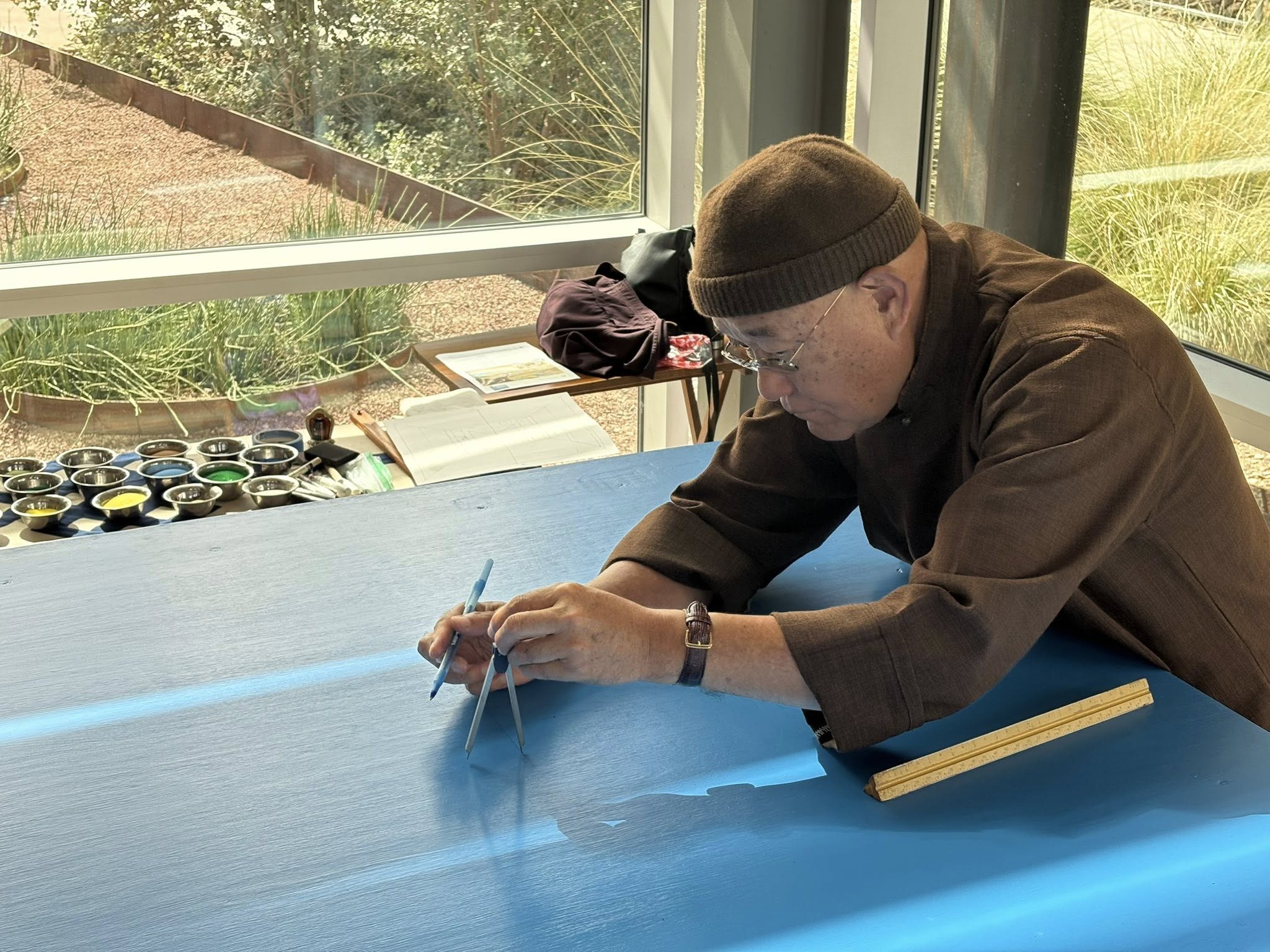
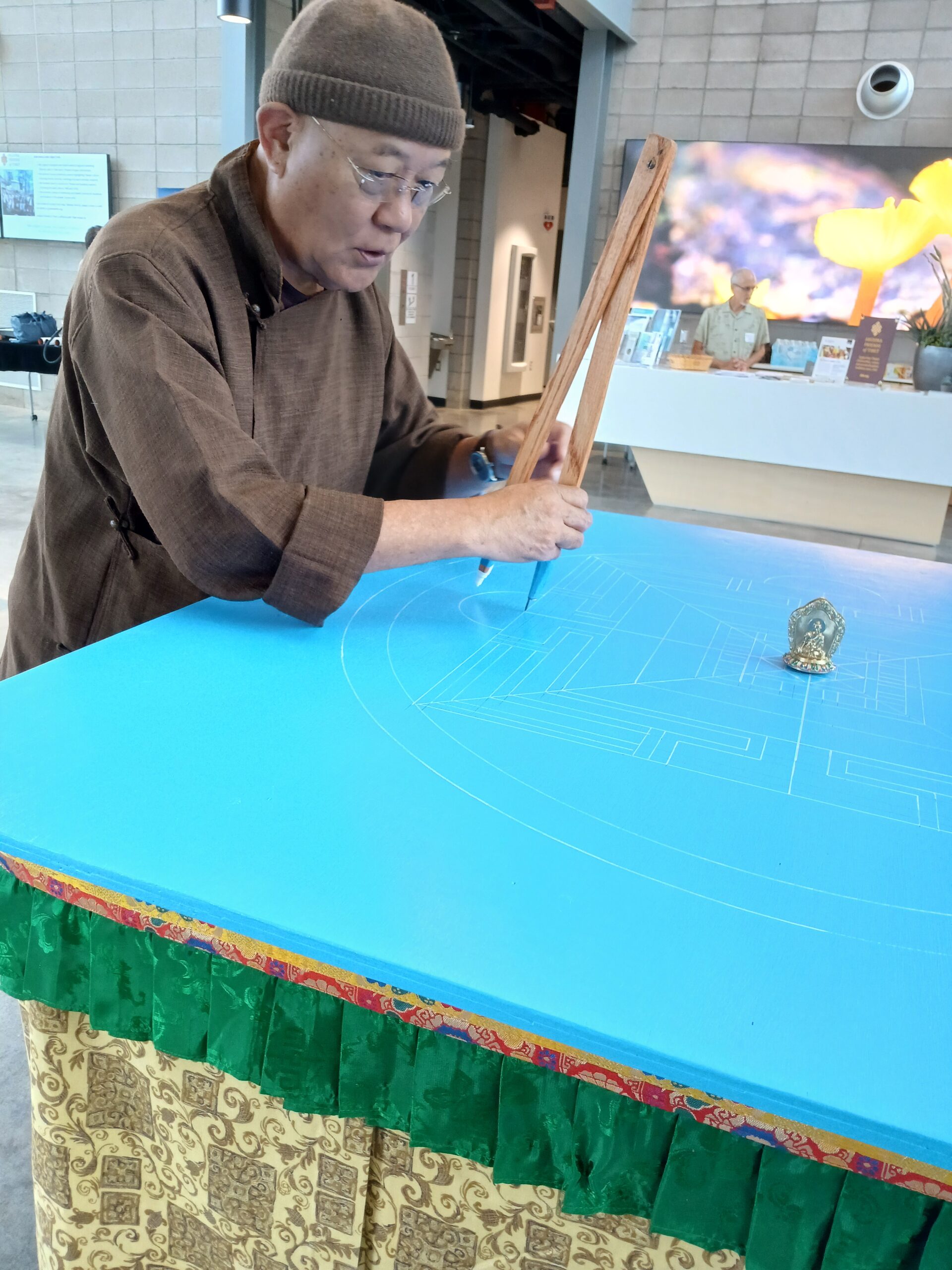
Drawing perfect circles is difficult, but Losang-la manages it with skill and charm
The Mandala in Progress
With the opening ceremony complete, and the design of the mandala laid out in chalk on Losang-la’s blue work table, the lobby of the Weil Center went quiet until the afternoon work session.
There was only a small, reverent group of people there to see the moment when Losang put the first sand on the table. It was a breathtaking moment of ritual, potential, and the sense of peaceful transformation that is the purpose of the Kalachakra.
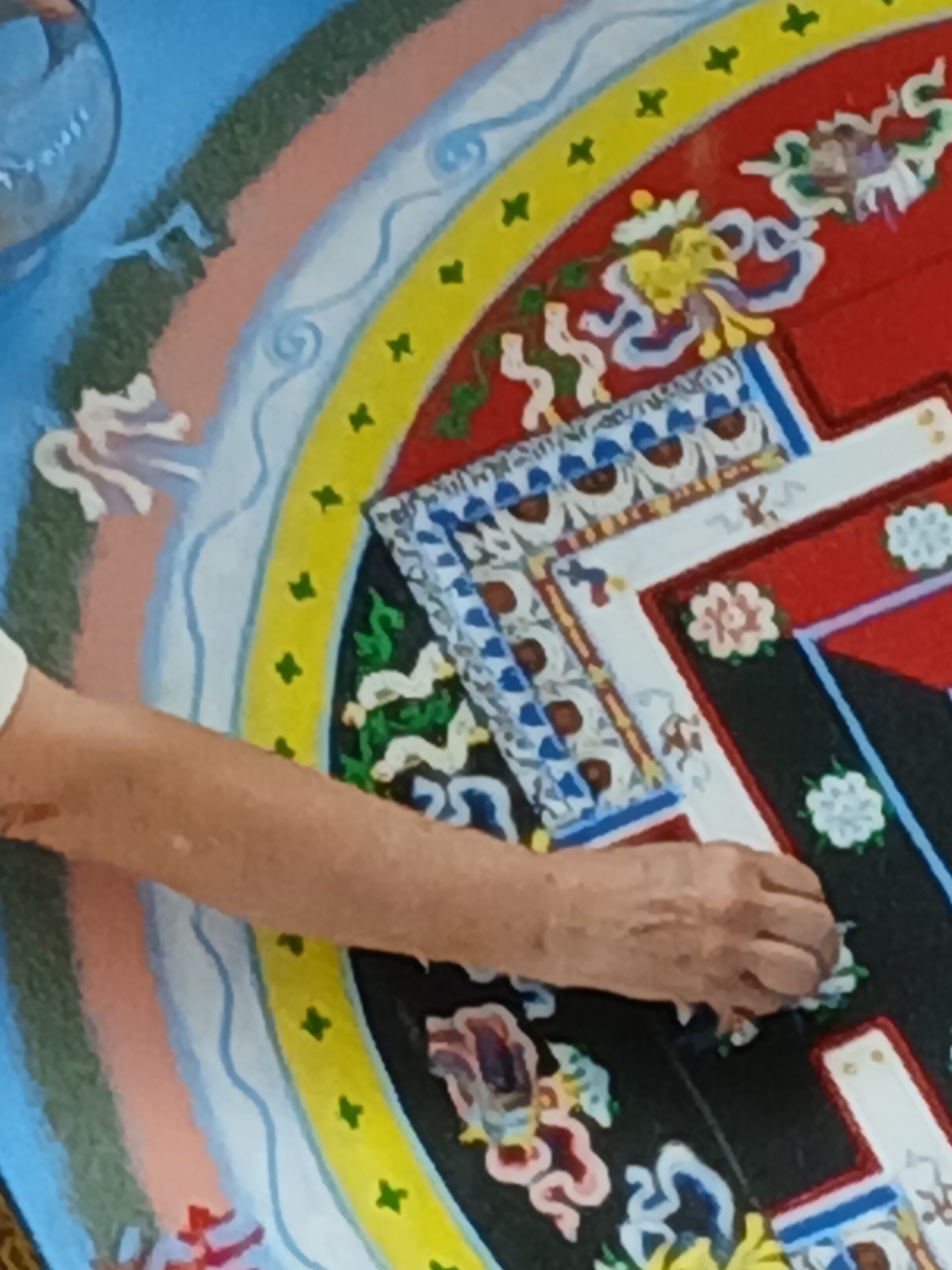
As with most sand mandalas, the Kalachakra is built from the center out. This particular center is considered the home of deities, and Losang-la applied that first yellow disc with appropriate solemnity. He then invited visitors, including Arizona Friends of Tibet President Steve Rosalik, to layer new colors over the top, with Losang beside them, quietly instructing and chanting. Each visitor’s layer completely covered the one before, and each added a different color to the table and represented a different natural element, such as Green for Air.
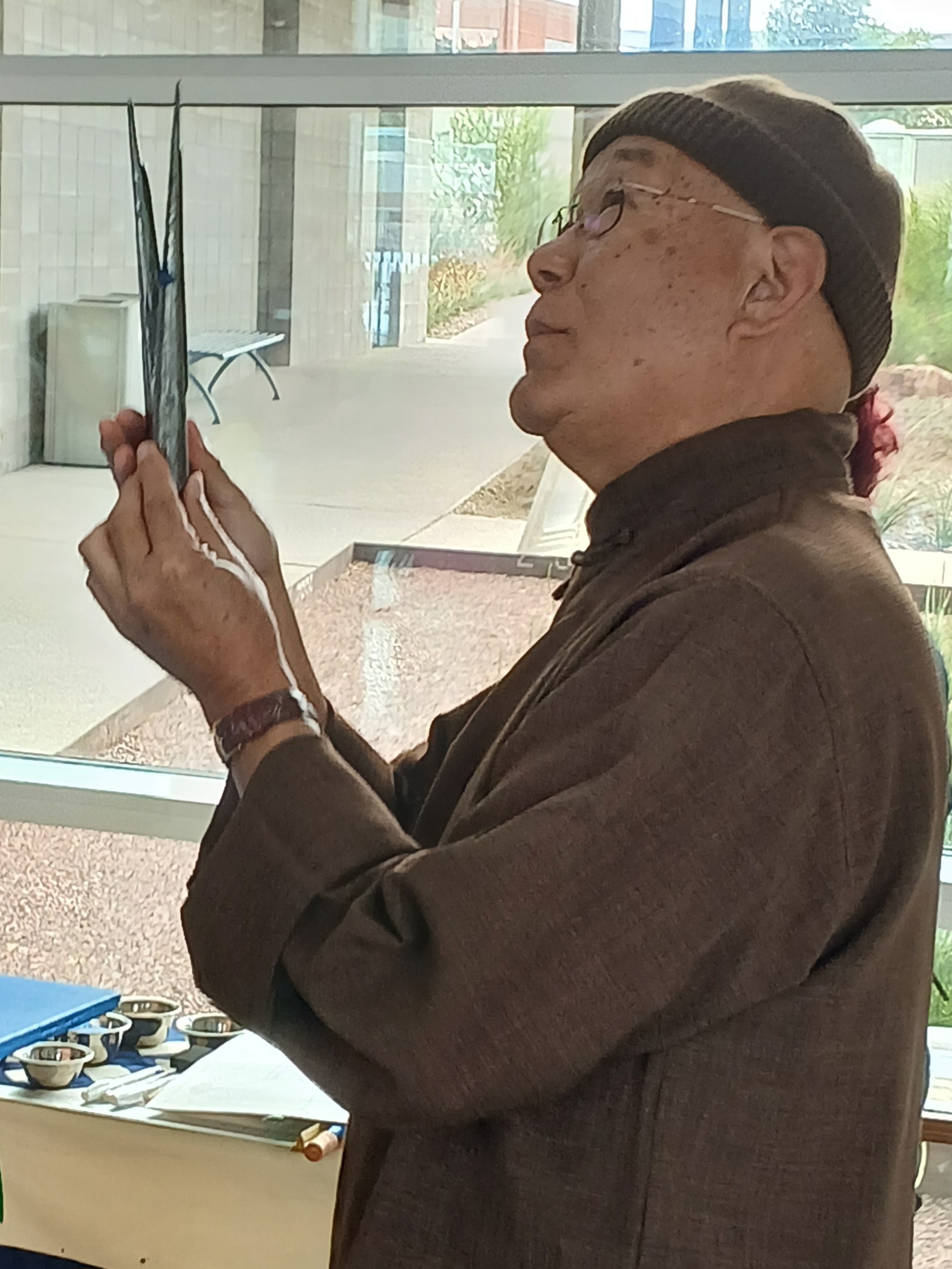
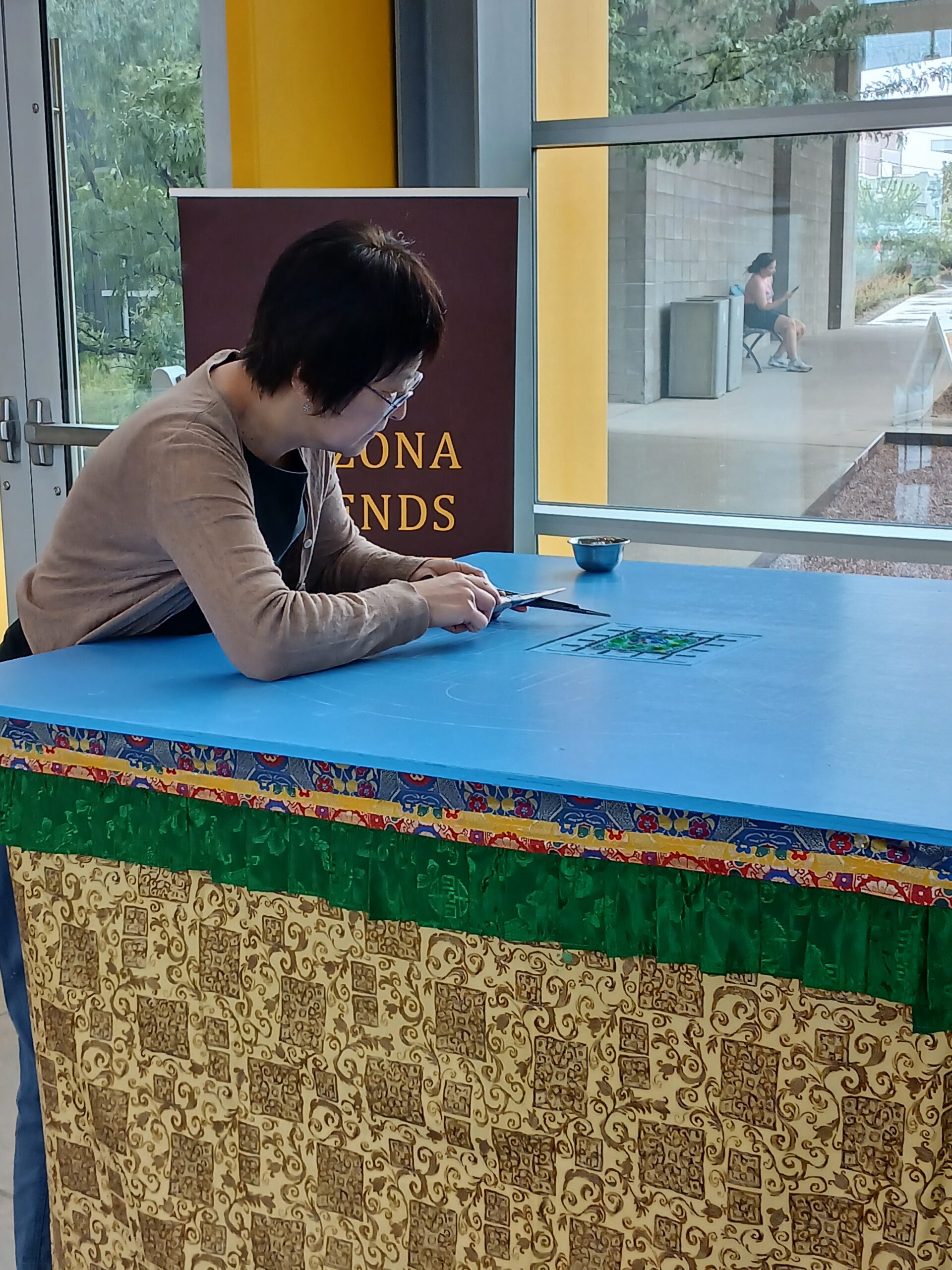
The sand for a mandala is applied using the chakpu (sometimes spelled chakpur) instruments. The chakpu is the paintbrush of the sand-mandala artist: a long metal funnel, narrow at one end, where sand is released by gently (but not too gently, as we discovered) rubbing an empty chakpu against the one holding the sand. The sounds the chakpu make together is the music of the mandala, and that music became the backdrop for the work sessions throughout the week.
President Steve Rosalik adds a layer onto the central circle
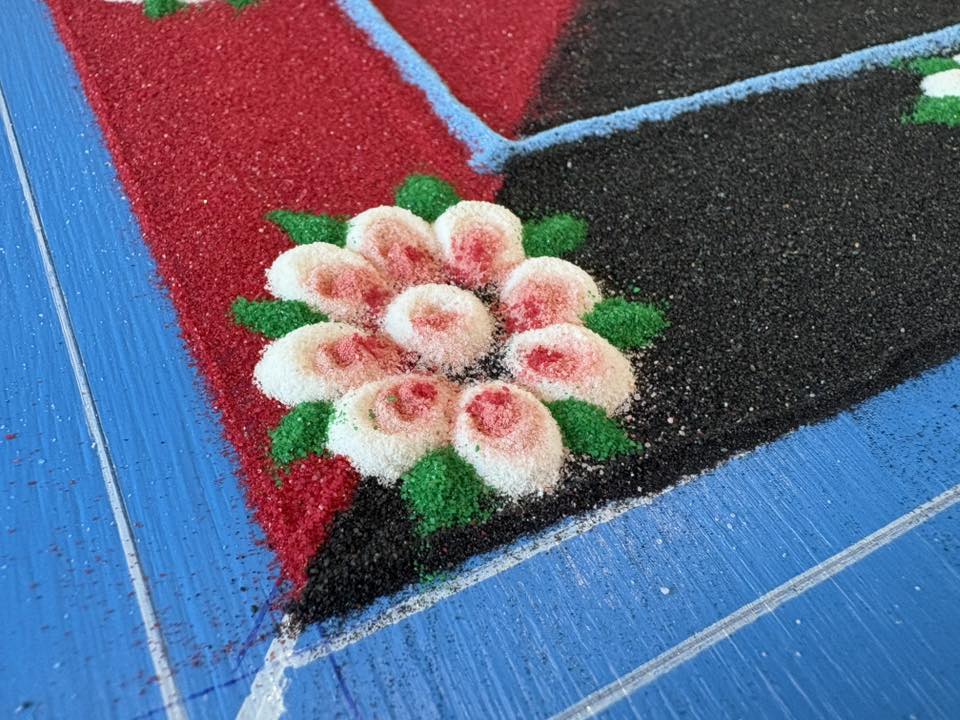
Mandala2.2_InProgress_FlowerDetail
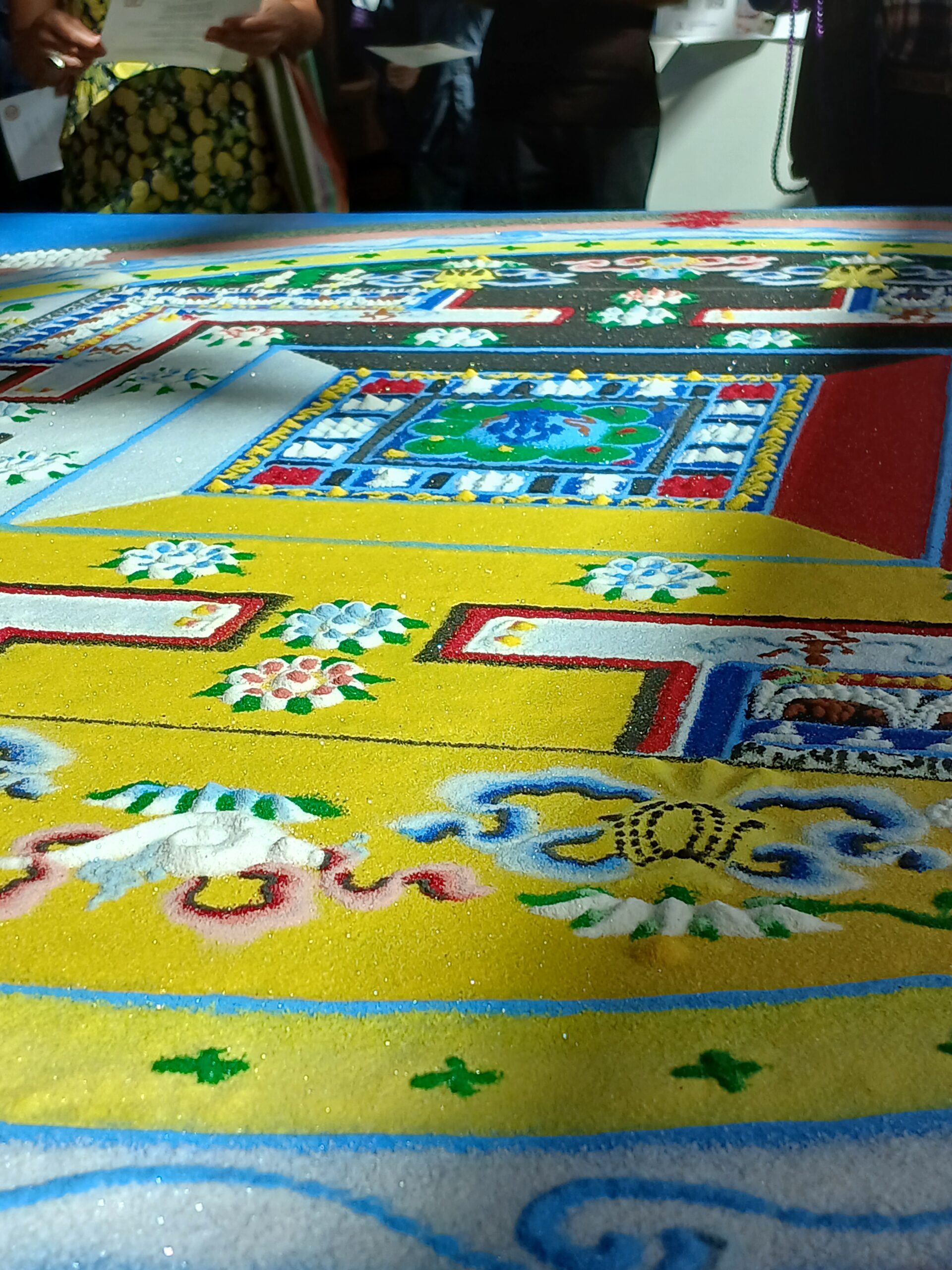
Detail of one of the delicate flowers dotting the mandala
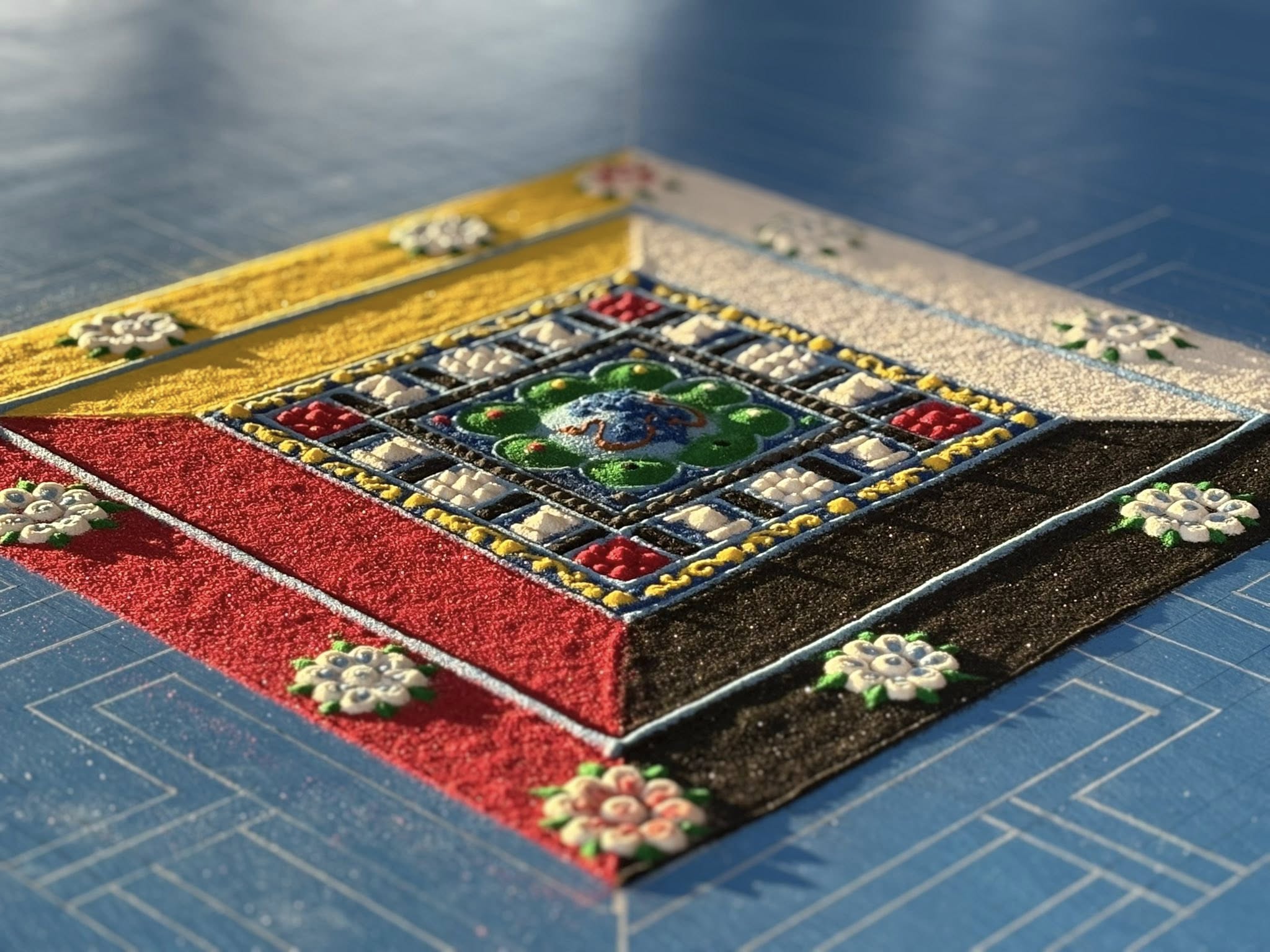
Mandala2.2_InProgress_BigSquareDiamond
A different perspective on the expanding design
Mandala2.1_InProgress3_Green
Losang-la begins work on the mandala, with the white outline showing how much work there is to be done
Mandala2.2_InProgress_LosangCenterSquare
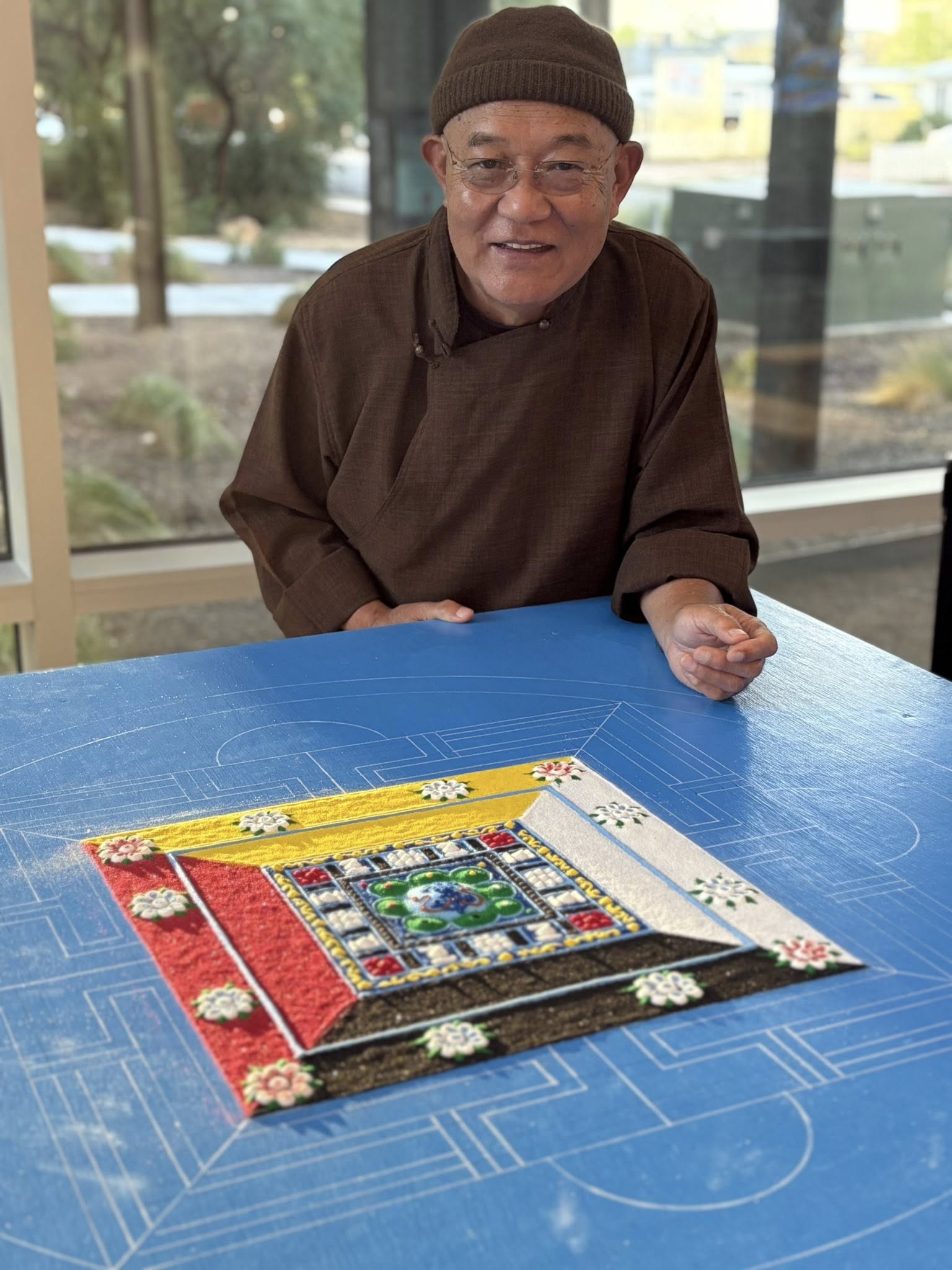
Losang-la smiles for the camera over the in-progress artwork
Mandala2.3_InProgressFinal_Brian
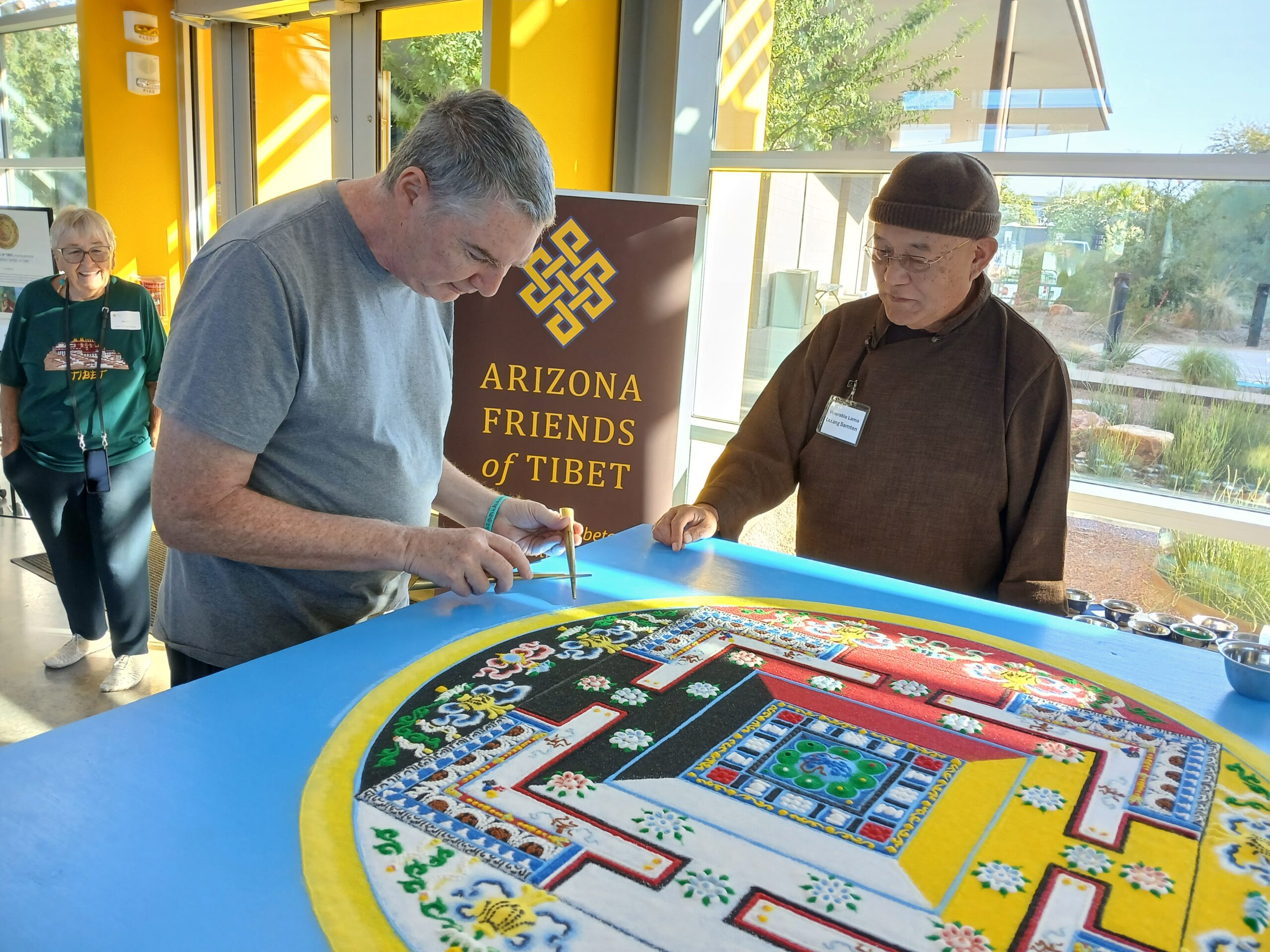
As seen in the video above, others are invited to assist with adding sand throughout the process
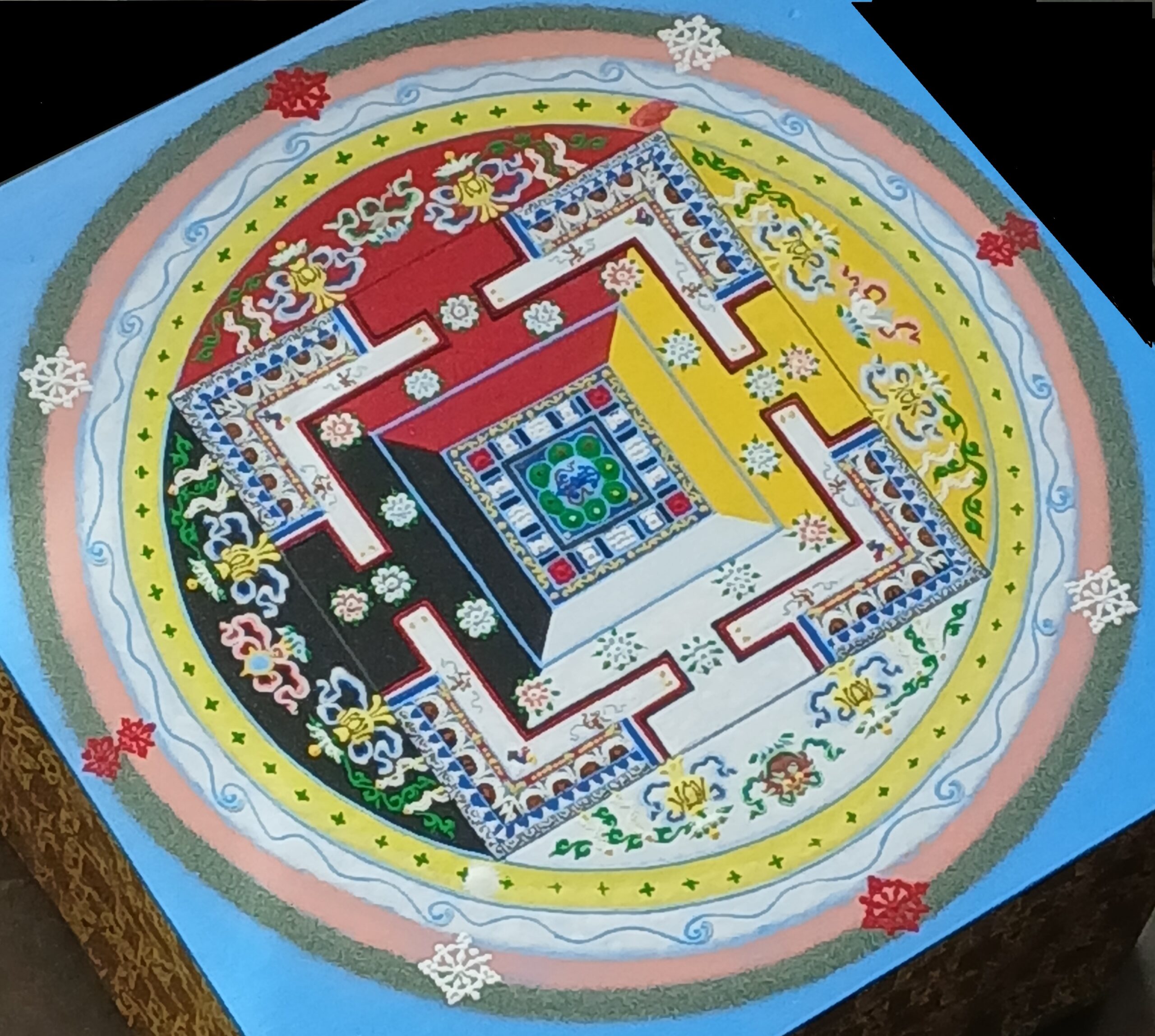
The Kalachakra Mandala Complete
Timelapse video coming soon! Check back here for updates.
Closing Ceremony
By Friday midday, the mandala was complete, richly colorful, full of meaning, and very much our sand mandala.
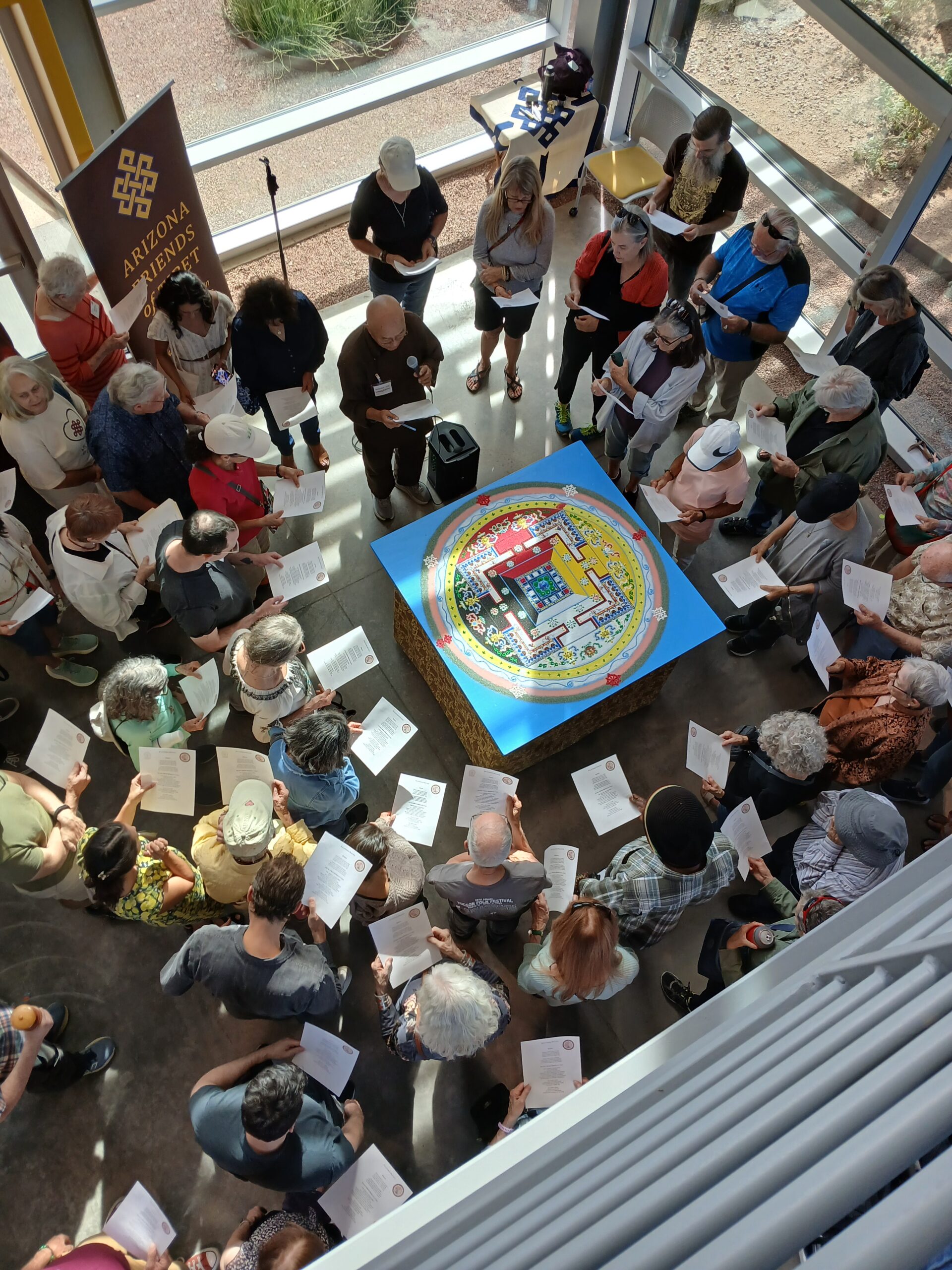
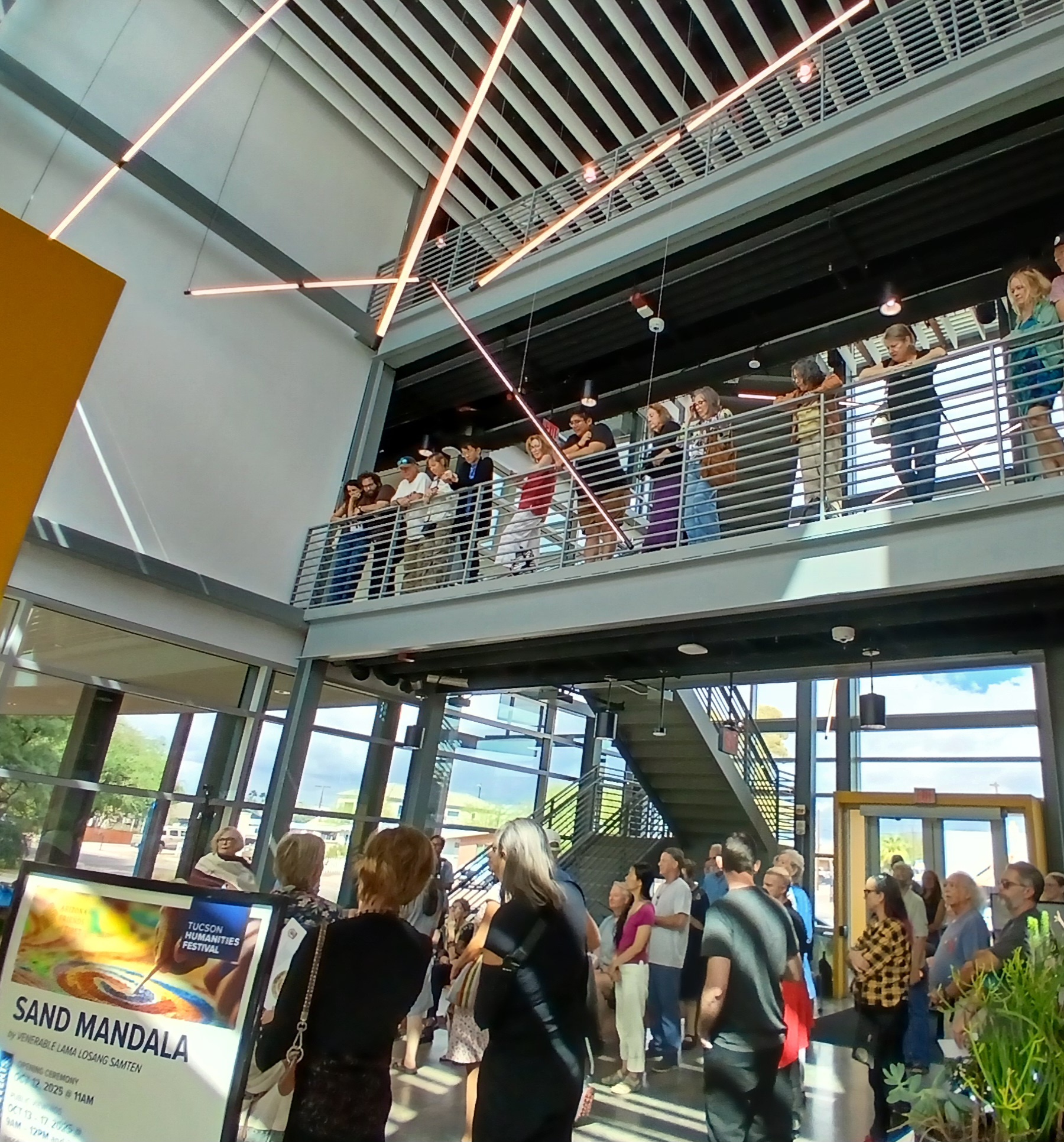
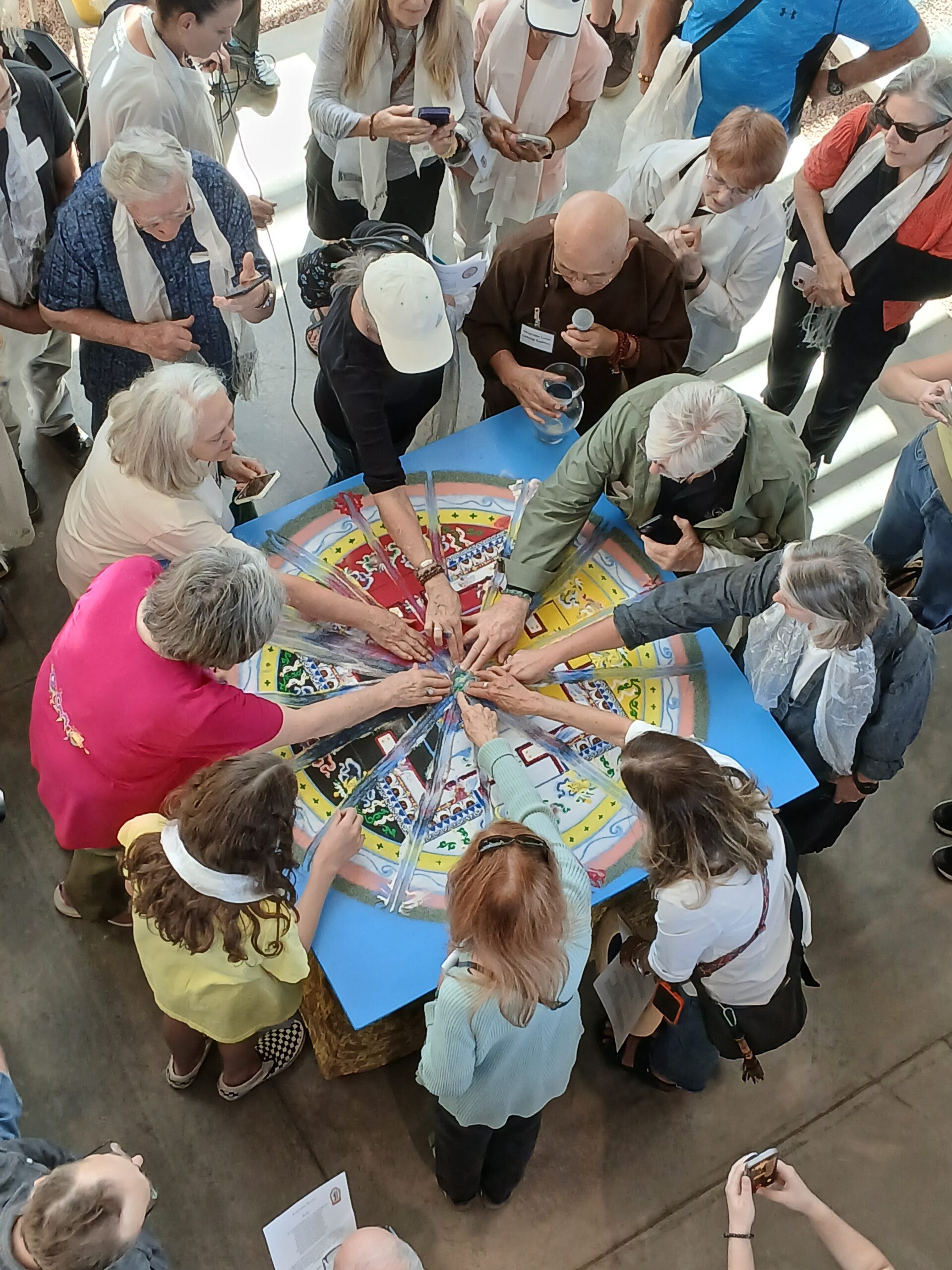
And then on Saturday, in keeping with ancient Tibetan Buddhist tradition, as well as with Buddhist teachings on the transitory nature of all things, the sand mandala was ritually destroyed. The closing ceremony, fondly dedicated to Arizona Friends of Tibet’s founder and President Emerita, the late Peggy Hitchcock, was heavily attended, with participants gathered in the lobby and on both balconies overlooking the mandala table. Losang-la led us in chants and song, and then invited nearby participants to remove specific elements of the design, one by one, with a final group of visitors pushing sand from the edges to the center before beginning to sweep it all into a pile in the middle of the table, where the many colors of our mandala blended together into a peaceful gray.
Once every visitor who wanted one received a small portion of sand to take home, Losang-la swept the remaining sand into a glass jar. That sand was later returned to a water source, to send the peace of Kalachakra back into the earth and complete the cycle of the mandala.
It was an incredibly moving day!
Our profound thanks to Venerable Lama Losang Samten, Soo Kyong Kim, our friends at the University of Arizona, our volunteers, our donors, and to everyone who contributed their presence and artistry to the sand mandala. We look forward to seeing you all at future events like this!
Losang-la leads the audience in singing “Down to the River to Pray,” an American folk hymn that Losang loves, here performed by Alison Krauss